How Do Barcode Scanners Work?
Barcode scanners are extremely common in our daily lives for use in completing transactions at the point of sale. Learn more about the purpose of barcodes and how scanners work to read them.

What is the Purpose of Using Barcodes?
Have you ever looked at a product that had a barcode or a UPC (Universal Product Code) symbol on it and wondered how a barcode actually works? Or how the scanners for reading them work? The use of barcodes on products is only an alternative labeling method. Nowadays, barcodes are used on products rather than price stickers by the vast majority of enterprises. Sometimes, because the label is ripped, faded, or wrinkled, the label cannot be read and the cashier has to manually punch the UPC number into the register. This makes for quicker checkouts as the cashier only needs to run the item’s UPC label over the scanner.
Essentially, a barcode is used to encode information that is able to be read by an external device. This is where the actual barcode scanner comes into play.
How Does a Barcode Scanner Work?
While there are a wide-range of scanners available on the market today, they mostly work in the same way with variations in scanning range and how easily the scanner can pick up barcodes depending on damage to the barcode. A barcode scanner reads the black and white lines, essentially empty vs filled space, of a barcode with a red light which is then converted to matching text. This information is delivered to a processor where it is processed and shown what it is actually representing. Most often this information is related to transaction processing, inventory management and various other data points related to information about a product.
A scanners main components are the illumination system to illuminate the barcode so it may be read, sensors which collect the image being scanned, and decoders which take the binary code read by the scanner and convert it into readable information.
Often when purchasing a barcode scanner, the price depends on the quality of these components in-addition to the variety of extra features as well as the ruggedness of the device as well.
To sum it up in simple terms, the barcode scanner scans a barcode and provides the computer or software with an electrical output via a decoder. The decoder is able to decipher the barcode type it is seeing by understanding the black and white zebra lines and transmits this data in a more easy to understand format. Often times this data can be dropped into excel or other simple spreadsheet software.
What About 1D and 2D Barcodes?
Another key criteria to consider when choosing a scanner is whether you will be scanning 1D or 2D barcodes or potentially both.
1D Barcodes – or linear barcodes use a series of variable width lines to encode the data and contain dozens of characters. 1D barcodes are encoded from left to right and get physically longer when more data is added to them. The most common 1D barcodes are UPC codes found on everyday consumer items you would find in any store.
2D Barcodes – Use patterns, shapes, or dots to encode information that work both horizontally and vertically. 2D is capable utilizing more characters than 1D with up to 2000 available vs just a couple dozen. 2D barcodes are useful when more information needs to be encoded than what a standard 1D would allow. The most common 2D barcodes are QR codes.

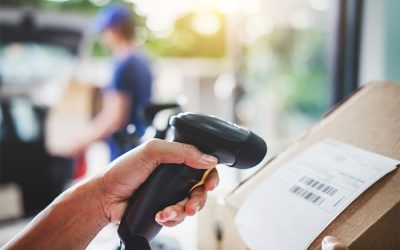
Barcode scanners are used at the point of sale in most transactions completed today.
Shop Barcodes at Barcode Giant